
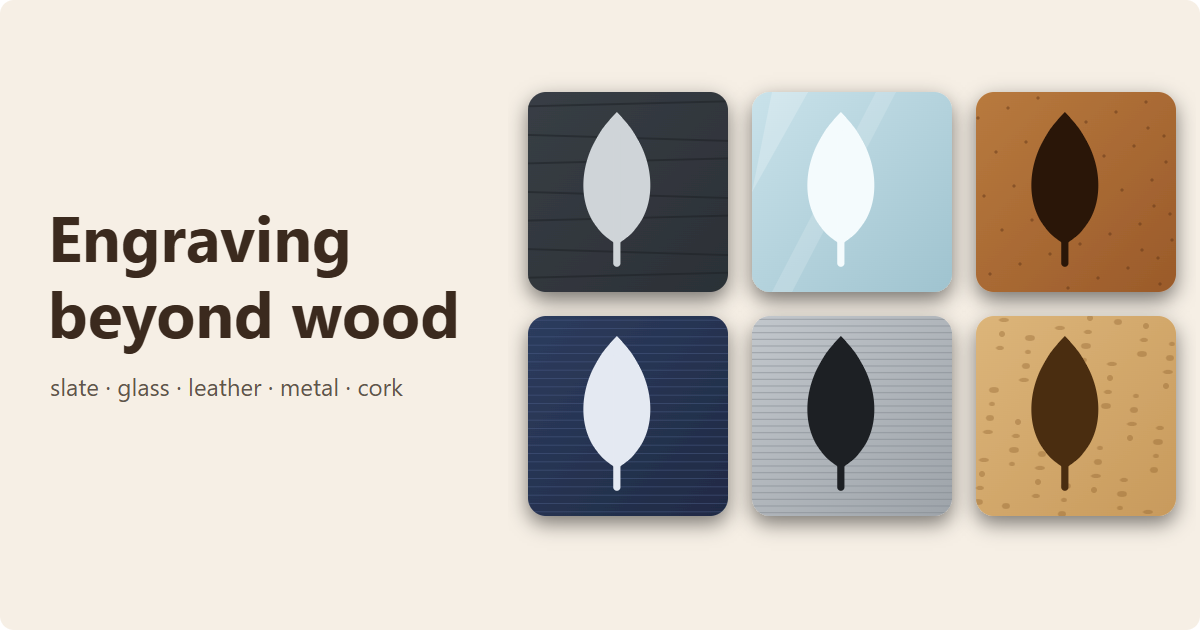
In short
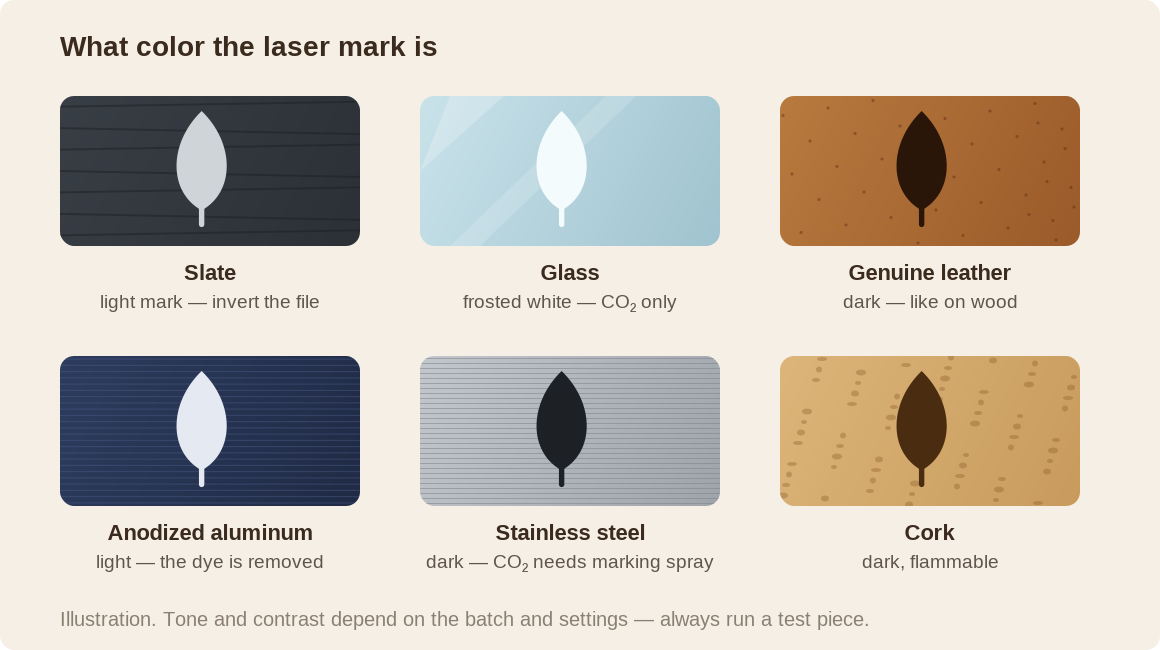
- Slate, anodized aluminum, black acrylic: the mark is light — invert the file (negative) and engrave what should be light.
- Glass is engraved by a CO₂ laser (a frosted mark from microfractures; wet paper towel or dish soap reduces chipping). A diode passes through clear glass — it marks only through a dark coating.
- Leather: vegetable-tanned — yes; chrome-tanned — manufacturers advise against it; PU faux leather — only with a verified composition; PVC — never.
- Stainless steel: a CO₂ laser marks it only through a marking spray or paste, a fiber laser (1064 nm) directly; strong diodes leave a dark mark, but results depend on the machine and the steel.
- Start every new material with the safety data sheet and a test piece — mark color and settings vary between batches.
Three lasers, three wavelengths
What a laser does to a material depends on whether the material absorbs its light. A CO₂ laser emits far infrared (10.6 µm) — absorbed by wood, acrylic, glass, stone, leather and paper, but not by bare metal. A diode laser (blue, about 450 nm) burns dark and opaque surfaces well, but passes straight through clear glass and clear acrylic. A fiber laser (1064 nm) marks metals and some plastics, while wood and glass are poor targets for it. We covered how they are built and how they differ in CO₂ vs diode laser; here we focus on what you see after engraving.
Safety first
Every manufacturer’s list of materials you must not laser looks much the same (Trotec, Epilog, xTool): PVC and anything containing chlorine (hydrogen chloride in the fumes — toxic, and it corrodes optics and rails), PTFE/Teflon, carbon fiber, materials with bromine (including many “flame-retardant” ones), epoxy and phenolic resins, and leather or faux leather containing chromium (VI). Polycarbonate yellows and smokes heavily — manufacturers allow thin films at most. The practical rule: a material without a safety data sheet from the supplier is an unknown material, and you don’t burn unknowns. How to spot PVC and set up extraction is covered in our guide to laser cutter safety.
Slate and stone
Slate is the workshop favorite among non-wood materials: coasters, signs, memorial plaques. The laser turns the dark surface into a light gray, chalky mark — high contrast on a cheap material. The consequence: in the file you engrave what should be light, so photos and artwork have to be inverted (“Negative Image” in LightBurn), as described in our guide to laser engraving photos. Both CO₂ and diode lasers engrave slate; cutting it is impractical because the stone is dense and brittle. Wipe the tile with a damp cloth and let it dry before engraving; afterwards a clear matte sealant or mineral oil deepens the contrast and protects the mark from dirt. A rough, split surface loses focus — pick the smoothest tiles for photos.
Granite and marble behave similarly: the mark is light, so dark stones give the best contrast and an engraving on light marble can be barely visible. A CO₂ laser engraves them with no preparation; manufacturers also list diode and fiber. Stone doesn’t burn, but the dust is abrasive — extraction, and clean the optics after a batch.
Glass
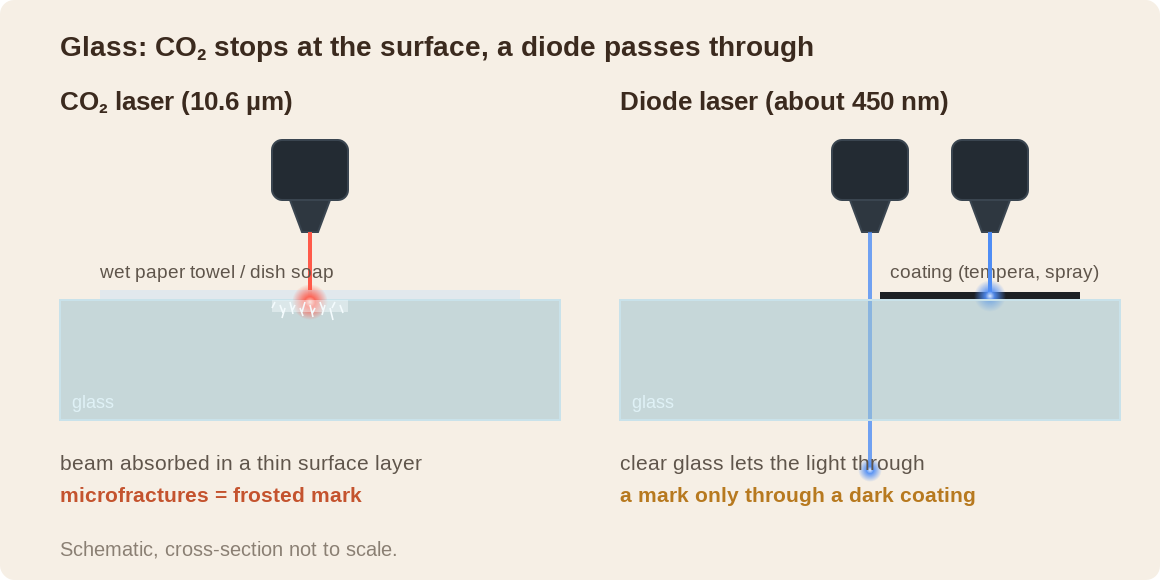
A CO₂ laser engraves glass directly: the infrared is absorbed in a thin layer at the surface, the glass fractures there into microscopic chips and you get a frosted white mark. For the same reason the engraving can feel rough, and larger areas may crater. Epilog’s advice: before engraving, cover the glass with a damp sheet of newspaper or paper towel, or coat it with a thin layer of dish soap — the moisture draws off heat and noticeably reduces cracking; masking tape works too. Keep the power on the low side, and remember that every kind of glass (soda-lime, crystal, tempered, bottle) reacts differently — a test on the same item is a must. Afterwards wash off the residue and wipe with a soft cloth; loose shards come off with a soft scouring pad. Bottles and stemware need a rotary attachment.
A diode laser emits light that clear glass lets through — the beam passes and heats the bed underneath. A mark appears only through a dark coating that absorbs the beam: xTool and other diode makers recommend black tempera paint (washes off with water) or laser marking spray; in practice people also use a black marker. The coating carries the heat into the glass and leaves a frosted mark that stays after the paint is washed off. Colored, opaque glass a diode engraves without a coating. A fiber laser practically does not engrave glass — the glass is transparent to it.
Safety: tempered glass can shatter completely, and chips are sharp — safety glasses and gloves when cleaning. None of these lasers can cut glass.
Genuine and faux leather
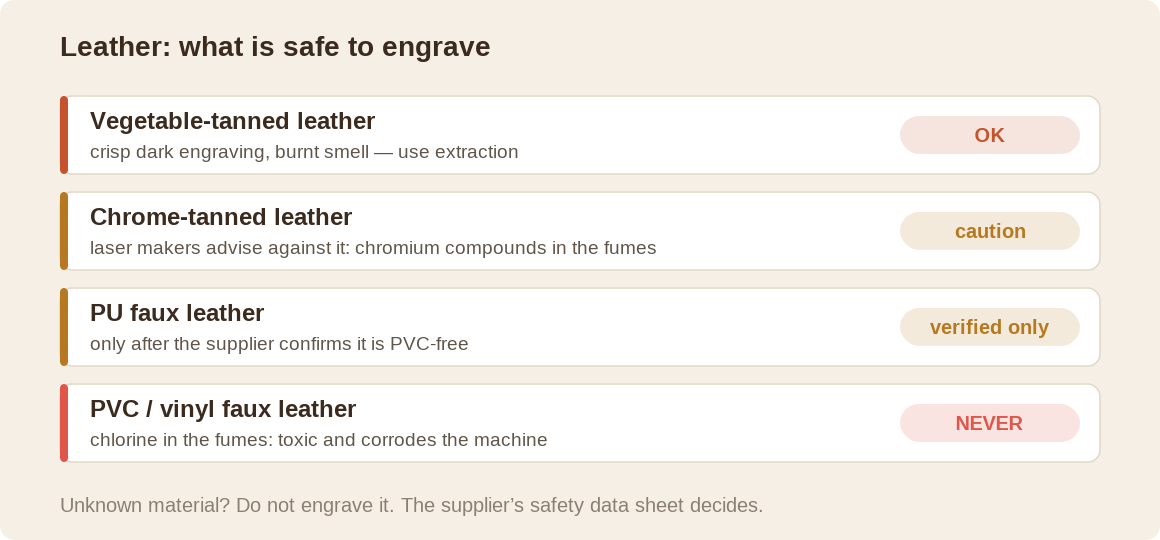
Vegetable-tanned leather is the best choice: the laser gives a crisp, dark, detailed engraving, and light cutting comes out clean. The smell of burnt leather is strong — extraction is mandatory, and air the finished piece out for a few days. Chrome-tanned leather (most garment and upholstery leather) is a problem: Trotec explicitly lists leather containing chromium (VI) among materials unsuitable for lasers, and Thunder Laser tells you to verify the tanning chemistry with the supplier. If you don’t know how the hide was tanned — don’t burn it.
Faux leather is a lottery. “PU” (polyurethane) material on a fabric backing can be engraved — there are even leatherette laminates made for lasers — but “eco leather”, “vegan leather” and “vinyl” often mean PVC, a banned material (hydrogen chloride in the fumes). Thunder Laser puts it bluntly: PU is not automatically laser-safe. Ask the supplier for the composition in writing; with no answer, treat the material as PVC. On leather, raster engraving at low power and high speed gives legible contrast without burning through; light leather shows more contrast than dark.
Anodized aluminum
Anodized aluminum (keychains, nameplates, enclosures, flashlights) has a thin, hard oxide layer on top, colored with a dye. CO₂, diode and fiber lasers all remove the dye and expose the light layer underneath — the engraving is white on a colored background, durable and with no consumables. Trotec recommends high resolution (600–1000 ppi) and very precise focus — blurred letter edges are almost always bad focus. Invert the file as for slate. Too much power bites into the metal and dulls the contrast, so start low and fast. Bare, non-anodized aluminum reflects a CO₂ beam — there you are back to marking spray or a fiber laser.
Stainless steel and other metals
A CO₂ laser does not mark bare metal — steel reflects the infrared. It works only with a marking spray, paste or tape (CerMark, TherMark and similar): you apply a thin coat, the laser fuses it to the surface as a permanent black mark, and you wash off the excess with water. This is marking, not engraving — no recess — but it is very durable. Manufacturers say it works on stainless steel and other hard surfaces; check the product sheet that the paste you choose is intended for your type of laser.
A fiber laser (1064 nm) marks metal directly in three ways: annealing (a dark mark from a change in the surface structure, no recess — stainless steel, titanium), engraving (vaporized metal, a wear-resistant recess) and layer removal (anodized aluminum, paint). It is a separate machine, although diode laser makers now sell swappable 1064 nm modules of low power — they mark steel, gold, silver, copper and titanium, slowly, and according to xTool cut at most 0.05 mm foil.
A 20–40 W diode laser leaves a dark oxide mark on matte stainless steel — Trotec and the diode manufacturers list stainless steel as a material diodes can engrave. The caveats: a polished surface reflects the beam and the result can be pale, contrast depends on the grade of steel, and at high power the mark can vary from piece to piece. Treat it as something to confirm on a sample, not a given. Brass, copper and bare aluminum reflect diode and CO₂ beams even more — that is fiber or marking-spray territory.
Cork, paper, cardboard
Cork engraves like soft wood: a dark, clear mark at low power. It is flammable and porous, though, so use air assist and watch every pass; cheap cork coasters are often bonded with a binder of unknown composition — the safety data sheet helps here too. Paper and cardboard can be cut and engraved with CO₂ and diode lasers (cards, invitations, stencils), but they ignite instantly: light engraving at low power, strong air assist, nothing unattended. Light card gives a brown mark that looks good in typography; cut edges darken, so die-cut shapes come out cleaner fast and in two passes than slow in one.
Acrylic, MDF, felt
Acrylic has its own rules — cast engraves frosted white, extruded less so, and clear acrylic can only be cut with CO₂ — and its own article on laser cutting acrylic. Black acrylic can also be engraved with a diode, and the mark is light, so invert the file. MDF and HDF engrave evenly and dark (glue and dust — good extraction), wool felt engraves well, synthetic felt melts at the edges.
Table: material × laser
| Material | CO₂ | Diode | Fiber | Mark and notes |
|---|---|---|---|---|
| Slate, stone | engrave | engrave | engrave | light mark — invert the file; cutting impractical; abrasive dust |
| Clear glass | engrave | only through a coating | no | frosted white mark; wet paper / dish soap; chips — safety glasses |
| Veg-tanned leather | engrave, cut | engrave, cut | — | dark mark; strong smell — extraction |
| Chrome-tanned, PU | caution | caution | — | only with a verified composition; chromium (VI) and PVC — no |
| PVC faux leather | never | never | never | hydrogen chloride in the fumes — toxic, corrodes the machine |
| Anodized aluminum | engrave | engrave | engrave | white mark — dye removed; precise focus, low power |
| Stainless steel | marking spray only | caution (dark mark) | mark, engrave | CO₂: paste fused to the surface; diode — depends on the steel and machine |
| Cork | engrave, cut | engrave, cut | — | dark mark; flammable; binder of unknown composition |
| Paper, cardboard | engrave, cut | engrave, cut | — | ignites instantly — air assist, supervision |
| Acrylic | engrave, cut | dark / opaque only | colored only | cast engraves white; clear cuts only with CO₂ |
The table collects manufacturers’ statements (Trotec, Epilog, xTool, Thunder Laser) — “engrave” means “it can be done”, not “it comes out well on every machine”. Always dial in power, speed and interval with a test grid on scrap.
With photos and artwork on slate, anodized aluminum or black acrylic, most of the time goes into preparing the file. In Plyground that is the job of the Photos for engraving module (Pro plan): crop the photo in millimeters, pick the material, and it inverts the image for dark materials (negative) and shows an “on material” preview with a simulation of your laser’s spot — you see how the portrait will come out on slate before you burn the first tile. Download the result as a PNG with DPI or a LightBurn project.
Frequently asked questions
Can a diode laser engrave glass?
Clear glass — not on its own: the beam passes through it. You have to coat it with something dark (black tempera, laser marking spray) that absorbs the light and carries the heat into the surface. Colored, opaque glass a diode engraves directly.
Can a CO₂ laser engrave stainless steel?
Not directly — metal reflects the infrared. A marking spray or paste (CerMark and similar) works: the laser fuses it into a permanent black mark. Stainless is marked directly by a 1064 nm fiber laser.
Why did my slate engraving come out like a negative?
Because on slate the laser mark is light, not dark as on wood. Photos and artwork have to be inverted before engraving — you burn the light parts and the dark ones stay stone.
What leather can you laser engrave?
Genuine vegetable-tanned leather. Laser makers advise against chrome-tanned leather (chromium compounds in the fumes), PU faux leather only after the supplier confirms it contains no PVC. Never burn PVC or “vinyl” leather.
What materials must never be laser engraved?
PVC and anything with chlorine, PTFE (Teflon), carbon fiber, materials with bromine and other halogens, epoxy and phenolic resins, leather with chromium (VI), beryllium oxide — and any material without a safety data sheet.